
Hyperscale Data Centers: What Every Community Should Know Before They’re Built

Artificial intelligence is transforming our world at an astonishing pace. Every day we ask AI questions, stream movies, store photos in the cloud, conduct business online, and rely on digital services that have become woven into nearly every aspect of our lives. Most of us rarely stop to think about the infrastructure that makes all of that possible.
That infrastructure isn’t floating somewhere in “the cloud.”
It exists in massive, industrial-scale facilities known as hyperscale data centers, and they are being proposed and constructed across the United States at a remarkable rate.
While these projects are often promoted as symbols of innovation and economic development, communities from Virginia to Ohio, Texas, Arizona, Georgia, Tennessee, and beyond are beginning to ask an important question:
What are the long-term impacts, and who is asking the hard questions before these facilities are approved?
This article isn’t intended to tell you what to think.
It’s intended to encourage you to learn more, ask questions, and become engaged if one of these projects is proposed in your own community.
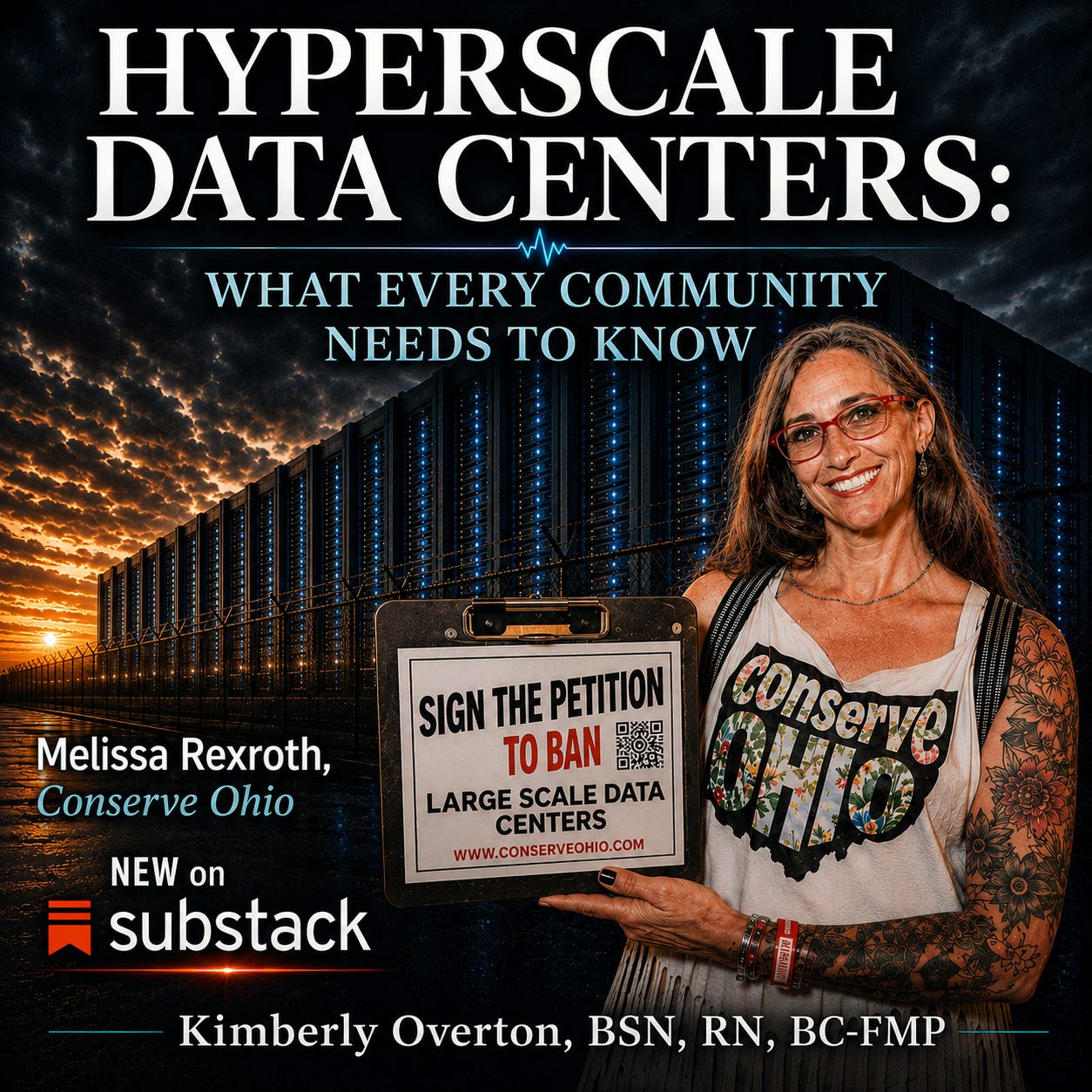
What Is a Hyperscale Data Center?
A hyperscale data center is exactly what it sounds like—a data center built on an enormous scale.
These facilities house tens of thousands, and sometimes hundreds of thousands, of computer servers that process and store information for cloud computing, artificial intelligence, social media platforms, streaming services, financial institutions, healthcare systems, government agencies, and countless businesses around the world.
Unlike traditional office buildings, these facilities operate around the clock, every day of the year.
Demand for hyperscale data centers has exploded largely because of artificial intelligence. Every AI-generated image, every chatbot interaction, every cloud backup, and every online search requires computing power. As AI continues to grow, technology companies are racing to build the infrastructure necessary to support it.
That growth is expected to continue for years.
The question many communities are asking is not whether technology should continue to advance, but whether its expansion should occur with greater transparency and public participation.
Why Communities Are Paying Attention
When a hyperscale data center is proposed, it often isn’t a small development.
Many projects span hundreds of acres.
Some require new substations, additional transmission lines, upgraded roads, and significant utility infrastructure.
While these projects can bring construction jobs and investment, they also raise questions that deserve careful consideration.
Energy Consumption
Perhaps the most discussed concern is electricity. Hyperscale facilities require enormous amounts of power to operate continuously.
Some consume hundreds of megawatts of electricity—comparable to the needs of an entire city.
As more facilities are constructed, utilities across the country are investing billions of dollars in expanding generation capacity and transmission infrastructure.
Residents naturally ask:
Will local electric rates increase?
Will additional power plants be required?
How will this affect long-term grid reliability?
Who ultimately pays for these infrastructure upgrades?
These are important questions that deserve public discussion before—not after—projects are approved.
Water Usage
Electricity is only part of the equation.
Servers generate tremendous heat, requiring sophisticated cooling systems.
Many data centers rely on large volumes of water for cooling.
While newer technologies are reducing water consumption in some facilities, many proposed projects still require millions of gallons of water annually.
In communities already concerned about drought, agricultural needs, or population growth, residents are asking whether local water resources can sustain additional industrial demand. Water is more than an environmental issue. It is a public health issue.
Land Use and Community Character
Many hyperscale campuses occupy hundreds of acres.
Depending on the location, construction may replace farmland, forests, wetlands, or open green space.
Communities have expressed concerns about:
Loss of agricultural land
Wildlife habitat disruption
Increased truck traffic during construction
Permanent industrial development
Large transmission corridors
Security fencing
Backup generators
Continuous mechanical equipment
Every community has different priorities.
The important point is that citizens deserve an opportunity to understand how these developments may affect the places they call home.
Noise
One issue receiving increased attention is noise.
Unlike traditional commercial buildings, data centers never shut down.
Cooling systems, ventilation equipment, transformers, generators, and mechanical infrastructure operate continuously.
Residents living near existing facilities have reported persistent low-frequency noise that can be heard day and night.
Developers frequently conduct acoustic studies to demonstrate compliance with local ordinances, but many citizens continue to advocate for independent review and long-term monitoring.
Environmental Considerations
As technology companies pursue ambitious sustainability goals, many are investing in renewable energy and more efficient cooling technologies.
At the same time, environmental organizations and local residents continue raising questions about:
Energy demand
Carbon emissions
Water consumption
Habitat fragmentation
Stormwater management
Heat generation
Backup diesel generators
Communities increasingly want comprehensive environmental impact assessments before construction begins.
Economic Benefits vs. Long-Term Costs
Supporters point to several potential benefits.
These include:
Construction employment
Property tax revenue
Infrastructure investment
Technology growth
Increased economic development
Critics argue those benefits should be carefully weighed against potential long-term costs, including:
Utility infrastructure expansion
Tax incentives offered to developers
Limited permanent employment after construction
Increased demand on public utilities
Loss of farmland and open space
Reasonable people can disagree.
What should not be controversial is having these discussions openly.
The Rise of Grassroots Movements
One of the most encouraging developments surrounding this issue has been the rise of citizen-led organizations committed to educating their communities.
These groups are not asking people to reject technology, they are encouraging residents to become informed before major decisions are made.
Across the country, local citizens are attending zoning meetings, reviewing permit applications, speaking with elected officials, organizing educational events, and encouraging their neighbors to become involved in the process.
Their message is straightforward:
Communities deserve transparency, information, and they deserve a voice.
Conserve Ohio: Citizens Getting Involved
One organization helping lead that conversation is Conserve Ohio.
Conserve Ohio is a grassroots organization focused on educating residents about proposed hyperscale data center developments throughout the state and encouraging meaningful public participation in the decision-making process.
Rather than relying on slogans, volunteers have spent countless hours researching projects, reviewing public documents, organizing educational meetings, and helping citizens better understand the potential impacts these facilities may have on their communities.
Whether you ultimately support or oppose individual projects, organizations like Conserve Ohio remind us that local government works best when citizens are informed and engaged.
Our Republic is strongest when people participate.
If you are an Ohio resident, you can download a petition packet here.
Nurses Joining the Conversation
Recently, I had the privilege of interviewing two nurses—Melissa Rexroth and Nicole Bethel—who have become actively involved with Conserve Ohio and their efforts to educate the public.
As nurses, we spend our careers helping people understand complicated information so they can make informed decisions.
That same mindset carries over into our communities.
Our conversation explored questions many Americans may not have considered before:
Why are hyperscale data centers expanding so rapidly?
What role does artificial intelligence play?
What are the potential impacts on energy and water infrastructure?
How can citizens become involved in local discussions?
What questions should communities ask before approving projects?
Regardless of where you stand on this issue, education should always come before opinion.
I encourage you to listen to the conversation and decide for yourself.
🎙 Episode Airs Wednesday June 17, 2026 at 10:00 AM, EST
Questions Every Community Should Be Asking
If a hyperscale data center is proposed where you live, here are a few questions worth asking:
How much electricity will the facility require?
Where will that electricity come from?
How much water will be used annually?
What happens during drought conditions?
What independent environmental studies have been completed?
How will nearby residents be protected from noise?
What tax incentives are being offered?
How many permanent local jobs will actually be created?
What happens if the facility becomes obsolete decades from now?
What restoration plans exist if operations cease?
Asking questions does not make someone anti-technology. It makes them an engaged citizen.
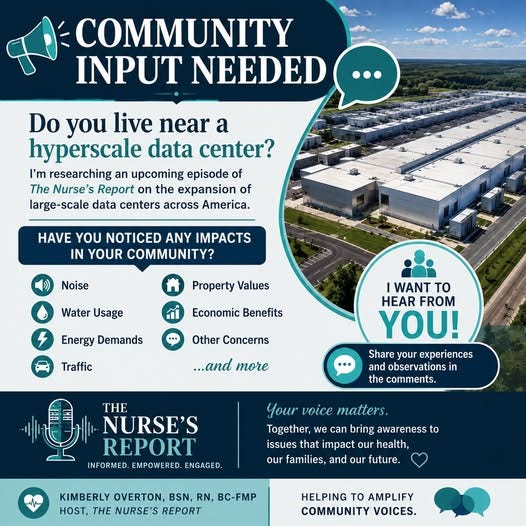
Have Hyperscale Data Centers Impacted Your Community?
We want to hear from you.
Across the country, communities are raising concerns about the rapid expansion of hyperscale data centers. Residents are reporting increased noise, water consumption, land use changes, environmental concerns, higher utility demands, and a lack of transparency in the approval process.
If a hyperscale data center has been proposed, approved, or constructed in your community, we’d love to hear your story.
Tell us:
Where are you located?
Is the data center proposed, under construction, or already operating?
How has it affected your community?
Have you experienced changes in noise, water usage, property values, traffic, or local infrastructure?
Have local officials been transparent throughout the process?
What do you wish your community had known before approval?
Every story helps paint a clearer picture of what’s happening across the country. Your experience may help educate other communities before these projects come to their own neighborhoods.
Please share your story in the comments below. We may feature your story in a future article or podcast episode (with your permission).
Together, we can build a national conversation about the real-world impact of hyperscale data centers.
Final Thoughts
Technology will continue advancing.
Artificial intelligence will continue reshaping the world around us.
Hyperscale data centers will undoubtedly remain an important part of that future.
The question is not whether these facilities should exist.
The question is whether communities deserve full transparency, meaningful public participation, and thoughtful discussion before projects of this magnitude are approved.
Healthy communities are built on informed citizens.
Whether this issue affects your town today or years from now, I encourage you to learn more, stay engaged, and participate in the conversations taking place at the local level.
Because once the decisions are made, they are often far more difficult to reverse than they are to influence in the beginning.
Nurses’ Notes is a reader-supported publication. If you find our content to have value, please consider becoming a paid subscriber. 100% of these proceeds are used to further the mission of Nurse Freedom Network.
About the Author:
Kimberly Overton, BSN, RN, BC-FMP, is a Registered Nurse, entrepreneur, and fierce advocate for medical freedom and informed consent. With a background in critical care and acute patient management, she bore witness to the systemic failures of a healthcare system corrupted by profit-driven protocols—protocols that led to medical murders disguised as care.
During the COVID-19 pandemic, Kimberly made the bold decision to resign from traditional bedside nursing, standing in protest against coercive mandates, the unethical use of Remdesivir, and the rollout of dangerous, ineffective COVID “vaccines.” This defining moment propelled her to establish Nurse Freedom Network, a 501(c)(3) nonprofit dedicated to empowering nurses, safeguarding patient rights, and exposing corruption within the healthcare system.
Today, she continues her mission at the bedside as a Hospice nurse, where she brings dignity, presence, and compassion to the end-of-life journey—honoring the sacred transition and advocating for comfort, truth, and informed decisions. Her experience in hospice care further reinforces the importance of understanding every medical intervention and upholding the nurse’s role as a protector of patient safety and peace.
Expanding on her mission, she launched Remnant Healthcare, providing holistic, patient-centered alternatives that honor medical autonomy, informed consent, and compassionate care. As host of The Nurses of America Out Loud, Kimberly amplifies the movement for healthcare reform, medical freedom, and the unwavering defense of human dignity.
Originally from Boston, Massachusetts, and now residing in Hendersonville, Tennessee, her mission is to disrupt the broken system, hold the profiteers accountable, and reclaim healthcare on a foundation of truth, ethics, and respect for human life—restoring humanity to the healing profession.
📲Connect with me and find all of our platforms in one place:
Watch my featured interview on The Jimmy Dore Show, which aired 5/18/26.
Watch my featured interview on the Michael Jaco Podcast, which aired 5/27/26
Watch my featured interview on With The Wind with Dr. Paul Thomas & DeeDee Hoover which aired on CHDTV.

In Need of a Medical Advocate? Remnant Healthcare Has You Covered!


Learn more about the promise of Stem Cells and Regenerative Medicine with Achieve Vitality


Gear Up Your Passion! Save 15% Off Your Purchase

Custom Healthcare Gear Made Just for You from MacAttack Gear
Now Available for Purchase

I was honored to have been selected by author Ken McCarthy to be featured in his latest book, What The Nurses Saw.

NOW AVAILABLE! Resuscitating Nursing is exactly the roadmap nurses need right now, and I couldn’t be more proud of my friend and colleague, Ashley Grogg, MSN, RN, BC-FMP for bringing this vision to life.

Now Available!! Order Your Copy Today!

Visit Our Online Shop for Official NFN & Remnant Nursing Merchandise

Listen to my latest episode here:

Find my past episodes here:

Listen to Nurses of America Out Loud Weekdays at 10:00 am, EST




Everyone needs to see this important film. Stay tuned to Nurses Out Loud for my upcoming interview with documentary filmmaker, Megan Smith, M.S.

This page includes affiliate links which if you choose to make a purchase from, I will receive a small commission at no extra cost to you. One more way to help support the work we are doing at Nurse Freedom Network.


Nurse Freedom Network is a Root Brands Ambassador, please click on the link below to sign up for your FREE Root Brands Account:


For the Busy Nurse on the Go!

Use Coupon Code: RemnantHealthcare


Use Coupon Code: Remnant

Save 10% on bookings using our referral link!


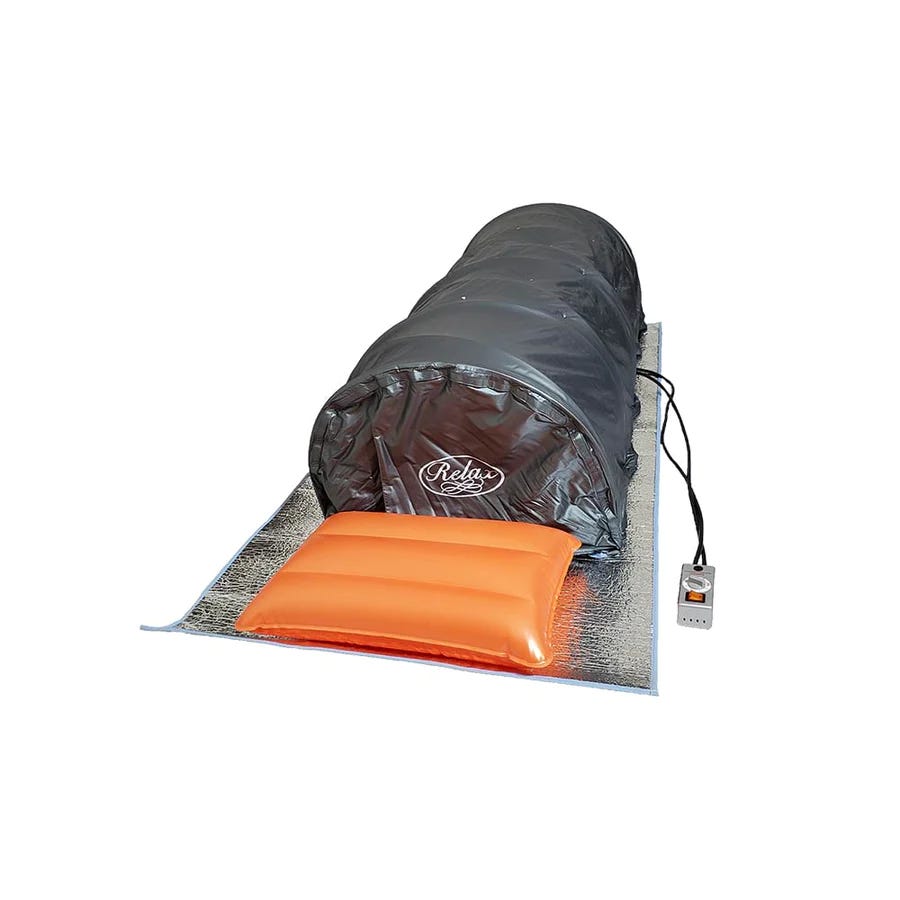
“Find me a way to create fever and sweat, and I will cure disease.”
~ Hippocrates, Father of Medicine
Increasing Core Temperature
Mobilizes Lymphatic and Immune Systems
Increases Circulation and Micro-circulation
Oxygenates Cells, Giving Greater Absorption
Activates Parasympathetic Nervous System
Helps Mitochondria Create ATP + Nitric Oxide

Use Coupon Code REMNANT NURSING to enjoy our discounted rate!


Use Coupon Code REMNANT10 to enjoy our discounted rate!
Healthcare Practitioners:
Learn more about how LabSmarts can enhance your practice and help ensure optimal health outcomes for your clients - Use Coupon Code RemnantNursing to enjoy a 10% Discount on their products and services!


Use Coupon Code REMNANT_NURSING at checkout to save 10%!




Freedom Square V2.0 is live!
Download the app today!

As a proud Co-Founder of the Freedom Chamber where we fuel dreams, forge connections, and champion American businesses, I invite you to join us on this mission. Together we build a future rooted in Faith, Family, and FREEDOM.
Be a part of a dynamic, innovative, and active movement to unite pro-American small and mid-size businesses. Freedom Chamber members will have access to exclusive benefits offered by our founding members and access to resources to navigate the ever-challenging business climate.


Cardio Miracle is made from the highest quality ingredients, driven and backed by science and committed to your health and well-being. Discount is automatically applied by shopping directly from our affiliate link below.
We are 100% supporter-funded and grateful for your kind donations that assist us in furthering our mission. We are a 501c3 non-profit organization making your kind contributions tax-deductible.
Nurses’ Notes is a reader-supported publication. If you find our content to have value, please consider becoming a paid subscriber. 100% of these proceeds are used to further the mission of Nurse Freedom Network.
Start writing today. Use the button below to create your Substack and connect your publication with Nurses’ Notes.
This is a FANTASTIC article. Thank you for tackling this very complex subject. People need to understand the impacts of large scale data centers. Erin Brokovich has a website with a map of current data centers, ones being built right now and ones that are planned.. Texas is overrun with the amount of farm land being gobbled up to put these in. Scary.
Using the Bill Gates model, infrastructure should feed AI and not useless eaters like ourselves. They are not worried about straining the system that exists as they’re in the process of destroying us and what we count on every day to exist.